On this date the San Francisco 49ers wide receiver Dwight Clark made a leaping fingertip catch from Joe Montana with 58 seconds remaining in the NFC Championship Game, securing a dramatic 28-27 victory over the Dallas Cowboys at Candlestick Park and launching a dynasty.
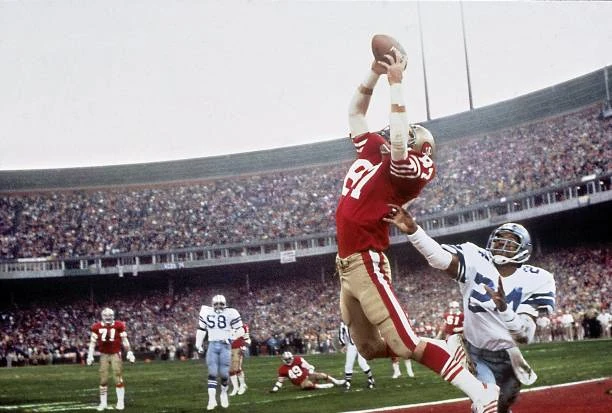
On January 10, 1982, at Candlestick Park in San Francisco, a moment unfolded that would forever define the San Francisco 49ers franchise and become one of the most iconic plays in NFL history. With just 58 seconds left in the NFC Championship Game, the 49ers faced 3rd down and 3 yards on the Cowboys' 6-yard line, trailing 27-21. What happened next became simply known as "The Catch."
Quarterback Joe Montana rolled right under intense pressure from Dallas defenders Ed "Too Tall" Jones, Larry Bethea, and D.D. Lewis. As the pass rush collapsed around him, Montana pump-faked to get the 6-foot-9-inch Jones to jump, creating just enough time to launch a high pass toward the back of the end zone. Wide receiver Dwight Clark leaped above Cowboys cornerback Everson Walls and made a fingertip grab that seemed to defy physics, securing the touchdown that put San Francisco ahead 28-27.
Source: 49ers.com
"The Catch" came at the end of a remarkable 14-play, 83-yard game-winning drive engineered by Montana. The 49ers had taken over at their own 11-yard line with the game on the line, needing to march 89 yards down the field against a Cowboys defense that had dominated the NFC throughout the 1970s.
The play itself, remembered in 49ers lore as "Red Right Tight - Sprint Right Option," called for both the primary receiver, Freddie Solomon, and Clark to line up on the right. Montana was supposed to roll right and find Solomon first. However, the Cowboys covered Solomon perfectly, and Clark's pattern had him cut left across the end zone, stop, and reverse his path to the right. If Solomon were covered, it would be up to Montana to improvise and find Clark.
Clark finished the game with 8 catches for 120 yards and 2 touchdowns, but it was that final grab that would be immortalized forever.
Source: Wikipedia
This game represented a watershed moment in the historic fortunes of both franchises. The 49ers had begun the 1970s winning three consecutive NFC West titles but spent the remainder of the decade as a losing team. Under head coach Bill Walsh, who was in his third season, the team had gone 2-14 in his first year and 6-10 in his second.
Walsh had called for the iconic play after head coach discussions with quarterbacks and passing game coordinator Sam Wyche on the sideline. As Clark recalled, "I come to the sideline, and I can hear Bill is talking on the headset to Sam Wyche, and they're talking about sprint right option. I knew I had a chance to get the ball, but my main job was to help get WR Freddie Solomon open."
The victory marked the beginning of something special. The 49ers would go on to win Super Bowl XVI two weeks later, defeating the Cincinnati Bengals 26-21 for their first championship.
Source: 49ers.com
Meanwhile, this game marked the end of the Cowboys' dominance in the NFC. Dallas had been the conference's most successful team since its inception in 1970, appearing in five Super Bowls during the decade and winning two. The Cowboys had also appeared in 10 of 13 conference championship games heading into this matchup.
The third time proved to be the charm for San Francisco. Three months earlier, the Cowboys had left Candlestick Park after a humiliating 45-14 loss to the 49ers. But the Cowboys fought back in the championship game, with the lead shifting back and forth repeatedly. Running back Tony Dorsett had scored earlier to give Dallas the lead, and the game featured several momentum swings.
After "The Catch," the Cowboys never returned to the Super Bowl in the 1980s. They reached their third straight NFC Championship Game the following season but lost to the Washington Redskins 31-17. Beginning in 1986, Dallas suffered losing seasons for the remainder of the decade, leading to legendary head coach Tom Landry being fired by new owner Jerry Jones after the 1988 season.
Source: Wikipedia
"The Catch" symbolized the beginning of a 17-season run of excellence for the 49ers. Over the next dozen years, San Francisco would win five Super Bowls and make the playoffs eight out of the next ten seasons, becoming the NFL's best dynasty of the 1980s and early 1990s.
Montana went on to gain a reputation for his last-minute heroics and was elected to the Pro Football Hall of Fame in 2000, his first year of eligibility. The quarterback-receiver duo's connection on that January afternoon launched Montana's legacy as one of football's greatest clutch performers.
Clark later reflected on the play's enduring impact: "It's humbling really. I feel honored people are still talking about it, 25 years later. I am honored to be able to be a part of a play that was kind of the culmination of just this incredible surprise season. It's great to give 49er fans that moment that they can relive over and over and over."
Source: American Football Wiki
"The Catch" was immortalized by two dramatic broadcast calls. Vin Scully described the play on CBS Television, while Jack Buck had the call on CBS Radio. For several years in the 1980s and 1990s, Kodak featured a television ad to the tune of Barbra Streisand's "The Way We Were" featuring "The Catch" as shown by NFL Films, accompanied by the caption, "The 49ers grab a TD and a title."
In 2002, the NFL ran a series of advertisements promoting the playoffs using famous plays as a uniting theme. Actor Don Cheadle demonstrated the height of Clark's catch by standing on a stepladder in the end zone.
Montana and Clark re-enacted "The Catch" in observance of the 25th anniversary of the play as part of San Francisco alumni day activities at halftime of a game on November 5, 2006, at Candlestick Park. In 2018, two statues depicting the iconic moment were unveiled at Levi's Stadium with one showing Clark reaching high for the ball and the other with Montana's arms shooting into the air in celebration.
The moment even inspired future generations. Tom Brady, a Bay Area native who would go on to win seven Super Bowls himself, attended the game as a four-year-old and later said it made him aspire to become a 49er.
Clark passed away in 2018 after a courageous battle with ALS, but his legacy lives on through that unforgettable moment. As he once said, "I never get tired of talking about it; I never get tired of seeing it, because I sign pictures and send them to people. I see that catch every day."
The 1990s would see a renewal of the Cowboys-49ers rivalry fueled by "The Catch" game. The 1992-1994 seasons saw the Cowboys and 49ers face off in three straight NFC Championship Games, with the Cowboys winning the first two and the 49ers winning the last one. Each victorious team followed up with a Super Bowl title, proving that both franchises had reclaimed elite status.
January 10, 1982, stands as more than just a great play. It represents a turning point in NFL history, the moment when one dynasty ended and another began. "The Catch" remains one of the most replayed moments in sports, a fingertip grab that changed everything for two storied franchises and created a memory that 49ers faithful will cherish forever.
.png)

.jpeg)
