On this date in 1863, Union forces under General John McClernand and Admiral David Porter captured Fort Hindman at Arkansas Post, securing nearly 5,000 Confederate prisoners in a decisive victory that lifted Northern morale and cleared a key impediment to Union operations on the Mississippi River.
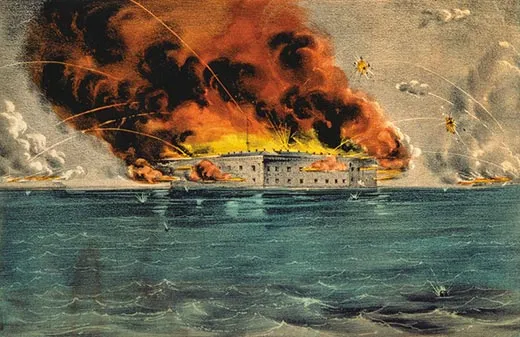
On January 11, 1863, Union General John McClernand and Admiral David Porter captured Arkansas Post, a Confederate stronghold on the Arkansas River. The victory secured central Arkansas for the Union and lifted Northern morale just three weeks after the disastrous Battle of Fredericksburg. Arkansas Post was a massive fort located 25 miles from the confluence of the Arkansas and Mississippi rivers, designed to ensure Confederate control of the White and Arkansas rivers while keeping pressure off Vicksburg, Mississippi, the last major Rebel city on the Mississippi River.
Source: HISTORY
The fort, known to Confederates as Post of Arkansas and to Union forces as Fort Hindman, sat atop a 25-foot bluff overlooking the Arkansas River. Each side of the square fortification was nearly 200 feet long, protected by a moat and surrounded by rifle pits and trenches. Confederate officials had ordered construction of the fort in late 1862 to prevent Union Navy gunboats from steaming upriver and capturing Little Rock. The position was commanded by Brigadier General Thomas J. Churchill, a talented commander who led approximately 5,000 men, mostly dismounted Texas cavalry.
Source: American Battlefield Trust
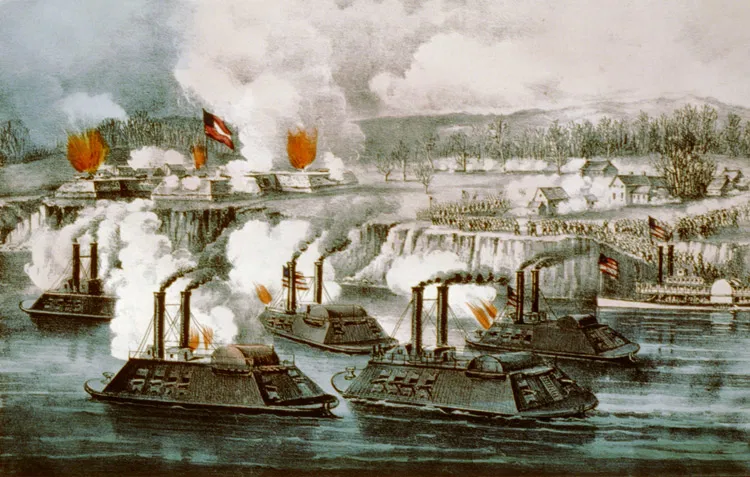
McClernand gathered his Army of the Mississippi at Milliken's Bend, just north of Vicksburg, with approximately 32,000 men in two corps commanded by Generals George Morgan and William T. Sherman. Though his main objective was Vicksburg, McClernand decided to capture Arkansas Post first after Confederate forces raiding from Fort Hindman captured a Union supply vessel, the steamer Blue Wing, loaded with armaments. The combined army-navy force began moving on January 5, 1863, with troops loaded onto 60 transports and led upriver by ironclads and gunboats. Union boats began landing troops near Arkansas Post on the evening of January 9, 1863.
Source: Wikipedia
Admiral Porter's gunboats began pounding the fort on the night of January 10, and the bombardment continued throughout the following day. Union infantry made a slogging assault overland while the naval vessels hammered Confederate positions from the river. The Confederate infantry put up a stubborn fight, driving Union attackers to ground with musketry as they tried to advance across scrubby cleared fields. However, Fort Hindman itself could no longer withstand the naval bombardment—walls tumbled down and guns flickered out of action one by one.
Source: American Battlefield Trust
The end came with some confusion on the afternoon of January 11. The first white flag appeared at 4:00 PM, hoisted by men of Colonel John Garland's brigade on the Confederate left flank. Unaware of these white flags, soldiers on the other side of the fort continued firing on Union troops who exposed themselves in response to the flags of truce. Admiral Porter himself was the first to climb into a hole in the fort's wall and secured the surrender of Colonel John Dunnington, the officer in charge of the fort's artillery. Out in the field, Sherman found General Churchill and demanded his surrender. Churchill, who had been ordered by theater commander Theophilus Holmes "to hold out until help arrived or until all were dead," had no choice but to comply.
Source: American Battlefield Trust
The battle resulted in the capture of nearly 5,000 Confederate prisoners—approximately one-fourth of the entire Confederate force in Arkansas. This was a catastrophic capture, not to be equaled west of the Mississippi River until General Edmund Kirby Smith surrendered the remainder of the department, some 20,000 men, on June 2, 1865, in Galveston, Texas. Union losses were surprisingly heavy considering their numerical advantage: 134 killed, 898 wounded, and 29 missing. Confederate casualties were lower at 60 dead and 75 wounded, but the loss of nearly 5,000 captured soldiers was devastating. Union forces also commandeered Confederate arms, ammunition, and supplies before razing Fort Hindman.
Source: Wikipedia and American History Central
When General Ulysses S. Grant learned of the operation against Arkansas Post, he initially disapproved and ordered McClernand back to the Mississippi River, viewing it as a diversion from the real objective of capturing Vicksburg. However, Grant was later convinced of the wisdom of the operation. The victory preserved Union commerce on the Arkansas and White rivers and removed the Confederacy's best chance of interfering with Union attacks on Vicksburg. Grant relieved McClernand of command on January 30 and took personal command of the campaign against Vicksburg, which would ultimately end with Confederate surrender on July 4, 1863—a key contribution to eventual Union victory.
Source: HISTORY
January 11, 1863, marked an important Union victory that came at a crucial moment. Just three weeks after the devastating Union defeat at Fredericksburg, the capture of Arkansas Post lifted Northern morale and demonstrated the effectiveness of combined army-navy operations. While the battle contributed little directly to the Vicksburg Campaign's ultimate success, it eliminated a significant impediment to Union operations on the Mississippi River and secured central Arkansas for the Union. The overwhelming capture of Confederate forces showcased the Union's growing military strength and foreshadowed the coordinated campaigns that would eventually win the war.
.png)