On January 14, 1784, the Continental Congress ratified the Treaty of Paris at the Maryland State House in Annapolis, officially ending the Revolutionary War and establishing the United States as an independent nation. The ratification came just in time to meet the six-month deadline, securing generous territorial boundaries and international recognition for the new republic.
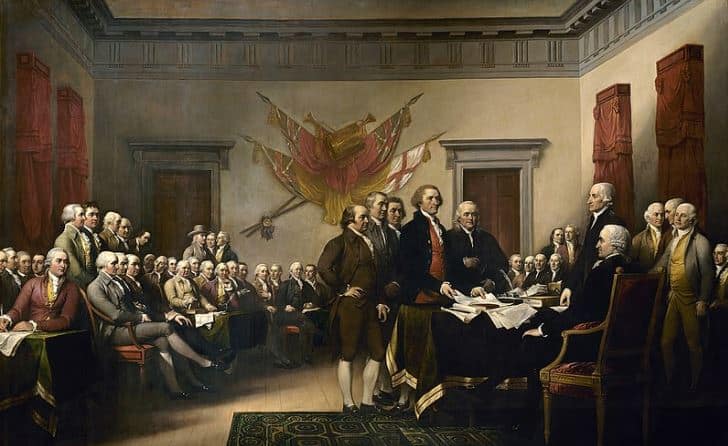
In the Senate Chamber of the Maryland State House in Annapolis, delegates from across the young nation gathered on a frigid January day to take the final, formal step toward American independence. With the arrival of Richard Beresford of South Carolina, barely meeting the deadline, the Continental Congress achieved the necessary quorum and unanimously ratified the Treaty of Paris, officially ending the Revolutionary War and securing America's place as a free and sovereign nation.
Source: Maryland State Archives
The Treaty of Paris had been signed in France on September 3, 1783, nearly two months after the British surrender at Yorktown. American diplomats Benjamin Franklin, John Jay, and John Adams had negotiated skillfully with their British counterparts, securing not just independence but generous territorial boundaries stretching from the Atlantic Ocean to the Mississippi River.
But signing the treaty was only half the battle. Under the Articles of Confederation, Congress needed nine of the thirteen states represented to ratify it. And the treaty stipulated that ratification must occur within six months of signing, with the document returned to England in time. Given that transatlantic crossings took nearly two months, the clock was ticking dangerously fast.
Delegates were called to convene at Annapolis, then serving as the nation's capital, in November 1783. But the severe winter of 1783-1784 made travel nearly impossible. Roads were impassable, rivers frozen, and delegates delayed for weeks trying to reach Maryland.
By mid-December, only seven states were represented in Annapolis. As January arrived and the deadline loomed, Congress grew increasingly anxious. Some argued they should ratify with just the seven states present, but Thomas Jefferson insisted that anything less than nine would be a "dishonorable prostitution" of the Great Seal of the United States. He feared that Britain would use insufficient ratification as an excuse to nullify the treaty, throwing America's hard-won independence into question.
Source: Maryland State Archives
The breakthrough came in early January. Two delegates from Connecticut, including Roger Sherman, arrived in Annapolis. Then came news that Richard Beresford of South Carolina was making his way to the capital, despite being ill and bedridden in Philadelphia.
On January 14, 1784, with Beresford's arrival, the quorum was finally reached. Twenty-three members from nine states were present. The vote was called, and the Treaty of Paris was ratified unanimously. After eight brutal years of warfare and months of anxious waiting, American independence was finally, officially secure.
Congress immediately ordered that a proclamation be issued, notifying all the states that the treaty had been ratified. In an era before telegraphs or telephones, this was no small task. John Dunlap, Congress's official printer, was commissioned to create broadsides announcing the momentous news.
Dunlap printed thirteen copies, one for each state, bearing the embossed seal of Congress and the signatures of Thomas Mifflin, president of Congress, and Charles Thompson, secretary. The broadsides proclaimed to "all the good citizens of these United States" that the treaty had been ratified and American independence was assured. Of those thirteen original copies, only a handful survive today. One sold at auction in 2007 for over $300,000.
Source: Maryland State Archives
Even with ratification complete, the race wasn't over. The ratified document still had to reach London and Paris before the six-month deadline expired. President Mifflin sent his private secretary to France by ship, carrying the precious document across the winter Atlantic.
Two couriers left later in January 1784 with versions intended for Benjamin Franklin in France and King George III in England. In March 1784, the British accepted the Americans' explanation that winter weather had delayed the documents' arrival in Europe. King George III ratified the treaty in April 1784, and the ratified versions were exchanged in Paris on May 12, 1784. The Revolutionary War was officially, definitively over.
Source: Maryland State Archives
The Treaty of Paris was remarkably generous to the young United States. Britain not only recognized American independence but granted the new nation territory stretching westward to the Mississippi River, nearly doubling the land area of the original thirteen colonies. The northern border extended to Canada, and the southern border reached Spanish Florida.
The treaty also guaranteed American fishing rights in the Grand Banks off Newfoundland and access to the Mississippi River. In return, the United States agreed to protect the civil rights of colonists who had remained loyal to Britain and to ensure payment of debts owed to British creditors.
On January 14, 1784, in a small chamber in Annapolis, Maryland, the American experiment moved from aspiration to reality. The Declaration of Independence had proclaimed the intention to be free. Victory at Yorktown had proven it was possible. But it was the ratification of the Treaty of Paris that made it official, binding, and permanent.
The document transformed thirteen rebellious colonies into "free sovereign and Independent States," recognized by the world's greatest empire. From that moment forward, the United States of America was no longer an idea struggling to survive but a nation with defined borders, international recognition, and a future limited only by the courage and vision of its people.
.png)