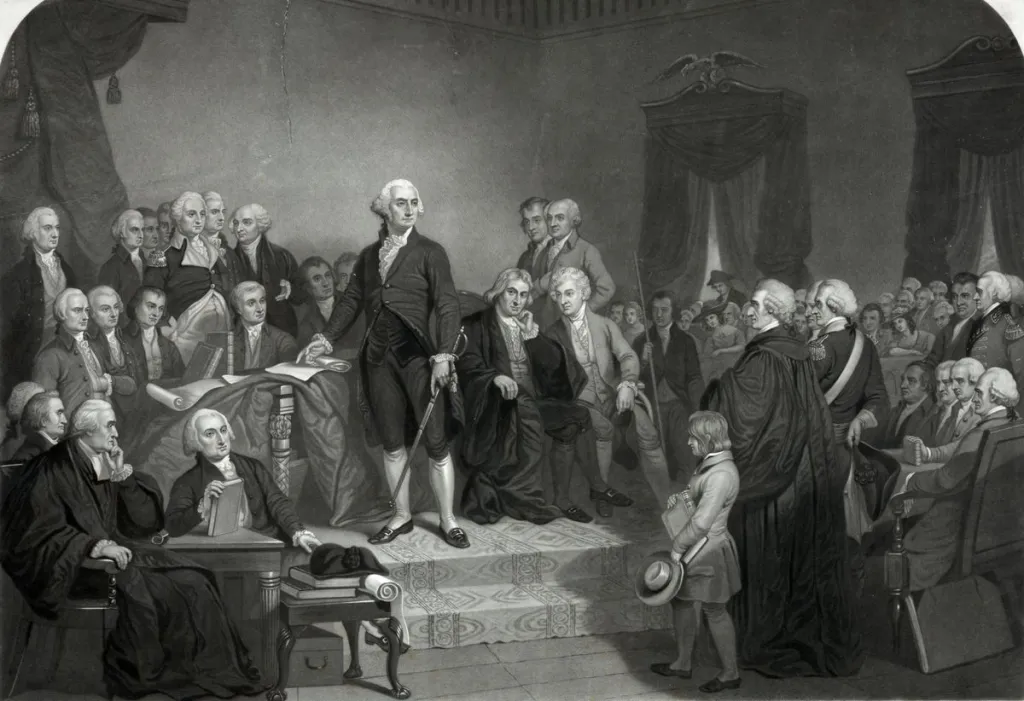
On January 8, 1790, President George Washington delivered the first State of the Union address to Congress at Federal Hall in New York City, establishing a precedent that continues to this day and fulfilling his constitutional duty to inform Congress about the nation's condition.
The State of the Union address is a constitutional requirement outlined in Article II, Section 3, Clause 1 of the United States Constitution, which states that the president "shall from time to time give to the Congress Information of the State of the Union, and recommend to their Consideration such measures as he shall judge necessary and expedient."
The address serves multiple purposes. It allows the president to report on the country's condition, outline policy priorities, propose legislation, and communicate directly with Congress and the American people. While the Constitution does not specify how this information should be delivered, Washington chose to present his message in person before a joint session of Congress, creating a tradition that most presidents would follow.
The ceremony we know today has evolved considerably since 1790, but the core purpose remains the same: to inform Congress about the nation's affairs and recommend measures for consideration.
Source: U.S. Senate
Washington delivered his address just over eight months after his inauguration on April 30, 1789. On January 4, 1790, he wrote to Vice President John Adams, who also served as president of the Senate, requesting to address both houses in a joint session as soon as they reached a quorum. Both the House and Senate achieved quorums on January 7, and Washington arrived at Federal Hall at 11:00 a.m. on January 8 to deliver his address.
As the first president, Washington understood that his actions would set precedents for future leaders. He took his constitutional obligations seriously and wanted to establish a formal, dignified process for communicating with Congress. Even details such as his choice of clothing became significant. Washington wore a crow-colored suit of American manufacture from Hartford, deliberately choosing domestically made clothing to support American industry.
Washington believed the address was an opportunity to unite the legislative and executive branches in pursuing the common good. He saw it as a way to outline priorities, encourage congressional action, and demonstrate the new government's commitment to transparency and accountability.
Source: Mount Vernon
Washington's address remains the shortest State of the Union ever delivered at just 1,089 words. He began by congratulating Congress on the recent admission of North Carolina to the Union. North Carolina had initially rejected the Constitution in July 1788 because it lacked a bill of rights, but ratified it in November 1789 after the first Congress wrote the Bill of Rights.
Washington then praised the nation's progress, noting "the rising credit and respectability of our Country, the general and increasing good will towards the Government of the Union, and the concord, peace and plenty, with which we are blessed."
The president outlined several key priorities. He emphasized national defense, famously stating that "to be prepared for war is one of the most effective means of preserving peace." He called for establishing a standing army and ensuring proper military funding and supplies, a controversial position given many Americans' fear of standing armies.
Washington also addressed the need for a uniform naturalization process for immigrants, uniformity in currency, weights, and measures, and the promotion of science and literature. He advocated for establishing a patent system to encourage innovation and suggested creating a national university to advance education, arguing that "knowledge is in every country the surest basis of public happiness."
The president discussed foreign policy, promising to fulfill his duty in that respect in the manner that best served the public good. He also addressed relations with Native American tribes on the southern and western frontiers, noting the need to protect settlers and, if necessary, punish aggressors.
Source: Wikipedia
Washington's first State of the Union established crucial precedents that shaped the presidency. By delivering the address in person before Congress, he created a tradition of direct presidential communication with the legislative branch. His formal approach elevated the office and demonstrated how the president could use such occasions to set the national agenda.
Congress responded quickly to several of Washington's recommendations. His call to promote science and literature led directly to the Patent Act of 1790 and the Copyright Act of 1790, both passed within months of his address. Washington signed the Patent Act into law on April 10, 1790, establishing the foundation for America's intellectual property system.
However, not all of Washington's suggestions were adopted. His proposal for a national university was questioned in the House of Representatives. Representative Michael Jenifer Stone raised concerns about constitutionality, arguing there was no authorization for Congress to fund such an institution. A national university was never established.
The tradition Washington began continued for over a century. Every president through William Howard Taft delivered their State of the Union in person. Thomas Jefferson broke with this practice in 1801, choosing to send written messages instead because he believed oral addresses too closely resembled the British monarch's Speech from the Throne. This written tradition continued until Woodrow Wilson revived the in-person address in 1913.
Today, the State of the Union remains one of the president's most important constitutional duties and a major moment in American political life, watched by millions and setting the tone for the year's legislative agenda. Washington's decision to deliver that first address in person over 235 years ago established the framework for how presidents communicate their vision to Congress and the American people.
Source: National Archives
.png)